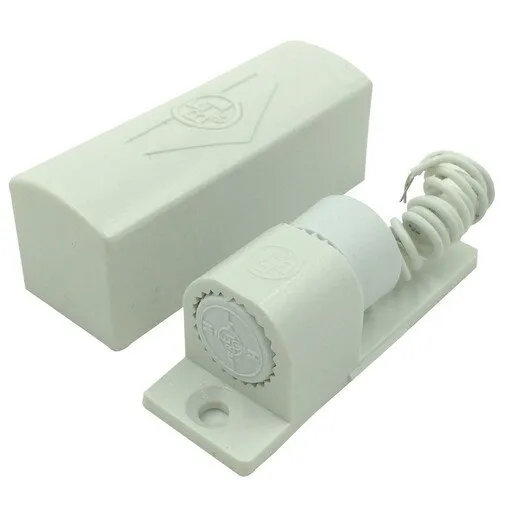
Vibration Sensor
KSh240.00 Excl. Tax
A vibration sensor, also known as a vibration detector or accelerometer, is an electronic device used to measure or detect vibrations and oscillations in physical objects and structures. Devices such as a Window and Door Alarm Vibration Sensor are examples of how this technology can be used for home security purposes.
Genuine product Secure checkout Warranty and order support Discounted Prices
Vibration Sensor
A vibration sensor, also known as a vibration detector or accelerometer, is an electronic device used to measure or detect vibrations and oscillations in physical objects and structures. Devices such as a Window and Door Alarm Vibration Sensor are examples of how this technology can be used for home security purposes.
In fact, a Window and Door Alarm Vibration Sensor provides an extra layer of safety for your home by detecting unauthorized entry attempts. It is commonly employed in various applications, including industrial machinery monitoring, structural health monitoring, automotive systems, and consumer electronics. Here’s a detailed description of a typical vibration sensor:
Components:
- Sensing Element: The core of a vibration sensor is its sensing element, which is responsible for detecting vibrations. There are various types of sensing elements, including piezoelectric crystals, piezoresistive materials, and capacitive sensors. The choice of sensing element depends on the specific application and the desired sensitivity.
- Signal Conditioning Circuitry: Vibration sensors often include signal conditioning circuitry to process the raw sensor output. This circuitry can amplify, filter, and convert the analog signal into a format suitable for further processing or display.
- Housing or Enclosure: Vibration sensors are typically housed in a protective enclosure to shield the sensing element from environmental factors, such as moisture, dust, and physical damage. The design of the housing can vary depending on whether the sensor is intended for industrial, automotive, or consumer use.
Operation:
The operation of a vibration sensor depends on its type. For instance, a Window and Door Alarm Vibration Sensor functions by detecting vibration signatures that indicate possible forced entry.
- Piezoelectric Sensors: These sensors use piezoelectric materials that generate electrical charges in response to mechanical deformation (vibration). When subjected to vibration, the piezoelectric material deforms, producing a voltage output proportional to the vibration intensity and frequency.
- Piezoresistive Sensors: These sensors rely on piezoresistive materials that change their electrical resistance in response to mechanical stress or deformation. Vibration causes a change in resistance, which is converted into a voltage signal.
- Capacitive Sensors: Capacitive vibration sensors measure changes in the capacitance between two closely spaced conductive plates. Vibration alters the spacing between these plates, resulting in a change in capacitance, which is then converted into an electrical signal.
Applications:
Vibration sensors find applications in various fields. Notably, a Window and Door Alarm Vibration Sensor is popular in residential and commercial security.
- Machinery Health Monitoring: They are used in industrial settings to monitor the condition of machinery, such as motors, pumps, and rotating equipment. Detecting abnormal vibrations can help predict equipment failures and prevent costly downtime.
- Structural Health Monitoring: Vibration sensors are used to monitor the structural integrity of buildings, bridges, and other infrastructure. They can detect vibrations caused by structural defects, earthquakes, or other external forces.
- Automotive: In vehicles, vibration sensors can be used for safety systems like airbag deployment, as well as for engine diagnostics and stability control.
- Consumer Electronics: Some smartphones and wearable devices use vibration sensors for features like screen orientation, step counting, and gaming feedback.
- Aerospace: In aircraft, vibration sensors are used for flight data monitoring, engine performance analysis, and structural integrity assessment.
Also Check:
Assenware AW-CSD311 – Conventional Smoke Detector
Related products

Automatic and Manual Burglar Alarm
Secolink GSV4B Economy class alarm system with GSM/GPRS communicator and keypad KM20B
Automatic and Manual Burglar Alarm

Automatic and Manual Burglar Alarm
Automatic and Manual Burglar Alarm