
Blog
Yeastar P-Series Product Features and Specifications
1. Introduction to the Yeastar P-Series
Yeastar’s P-Series is a modern Unified Communications (UC) platform that consolidates traditional telephony, video conferencing, collaboration, and call center features into one solution. It is available in three editions:
- Appliance Edition (P520, P550, P560, P570 hardware)
- Software Edition (install on your own server or VM)
- Cloud Edition (hosted by Yeastar or a partner)
This guide focuses on the P-Series Appliance Edition models.
Key Advantages
- Complete UC Features: Voice, video, chat, presence, file sharing.
- Call Center: Advanced queues, wallboards, agent reports.
- CRM Integration: Direct integration or API-based connectors.
- Linkus UC Clients: Desktop (Windows/macOS), Mobile (iOS/Android), Web client.
- Security: TLS/SRTP encryption, built-in firewall, intrusion detection (fail2ban).
- Scalability: License-based expansions for user and call capacity, plus modular telephony interfaces.
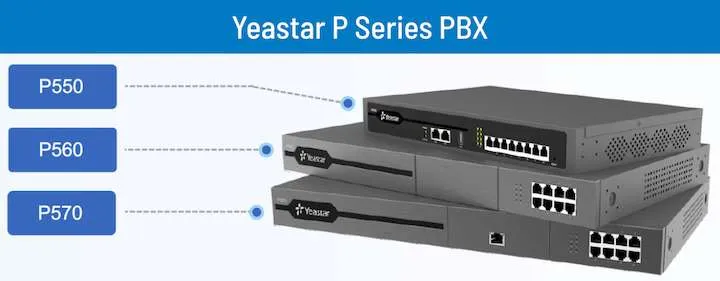
2. P-Series Appliance Models & Specifications
Yeastar currently offers four main P-Series PBX Appliance models: P520, P550, P560, and P570. Each differs primarily in user capacity, concurrent calls, and the number of module slots.
| Model | Base Users | Max Users (w/ License) | Base Concurrent Calls | Max Concurrent Calls | Expansion Slots | Ideal For |
|---|---|---|---|---|---|---|
| P520 | 20 | 20 (no expansion) | 10 | 10 | 1 | Very small offices |
| P550 | 50 | 50 (no expansion) | 25 | 25 | 1 | Small offices |
| P560 | 100 | 200 | 30 | 60 | 2 | Growing medium-sized businesses |
| P570 | 300 | 500 | 60 | 120 | 3 | Larger enterprises |
2.1 Common Appliance Hardware Features
- Gigabit Network Interfaces: 2 x RJ45 ports (WAN/LAN or dual LAN).
- USB Port: For external storage, firmware upgrades, or backups.
- Reset Button: Quick factory reset if needed.
- LCD Screen (on P560/P570): Displays basic device info (IP, system status).
- Built-in Storage: For call recordings, voicemail, logs (supports SD card or internal flash).
- Mounting: All models can be rack-mounted (1U) or placed on a flat surface.
2.2 Telephony Module Options
Like the S-Series, P-Series appliances support modular expansion for analog, digital, or cellular connectivity:
- EX08/EX30: Expansion boards to add more module slots (mainly for P560/P570).
- O2 Module: 2 FXO ports (analog trunk lines).
- S2 Module: 2 FXS ports (analog extensions for phones/faxes).
- B2/B4 Module: BRI ports (ISDN digital lines).
- GSM/3G/4G Modules: Cellular trunk for mobile backup or remote sites.
- E1/T1/PRI Module: Digital trunk for enterprise-level connectivity.
3. Key Software Features
3.1 Unified Communications & Collaboration
- Video Conferencing
- Built-in WebRTC conferencing; join via browser, share screen, group chat.
- Linkus UC Clients
- Desktop (Windows, macOS), Mobile (iOS, Android), and Web Client.
- Presence, instant messaging, file sharing, audio/video calling.
- Operator Panel
- Real-time status of extensions and queues.
- Drag-and-drop call transfer, monitor call flows.
- CRM Integration
- Built-in connectors for Salesforce, Zoho, etc.
- Screen pops, auto contact lookup, call journaling.
3.2 Call Center & Advanced Telephony
- Enhanced Queues
- Multiple ring strategies (ring-all, linear, round-robin).
- Real-time queue metrics, agent wrap-up, queue callback.
- Wallboards & Reporting
- Track call statistics, agent performance, SLA (Service Level Agreement).
- Historical reporting for queue performance analysis.
- Call Recording
- Automatic or on-demand.
- Manage recordings locally or on external storage (USB/SD).
- Core PBX Features
- IVR, call parking, pickup, forwarding, etc.
- Voicemail (voicemail-to-email), fax-to-email, call groups.
3.3 Security & Administration
- TLS/SRTP: Encrypt SIP signaling and media.
- Intrusion Detection (fail2ban): Auto-block suspicious IPs.
- IP Blacklist/Whitelist: Fine-grained access control.
- Web GUI Management: Intuitive browser-based interface; no CLI required.
- Backup & Restore: Schedule automatic backups to external or cloud storage.
4. Typical Deployment Scenarios
4.1 Very Small Office or Startup – P520
- 20 users, 10 concurrent calls.
- Perfect for micro-offices or specialized departments.
- Use 1 expansion slot if you need a small number of analog or cellular lines.
4.2 Small Office – P550
- 50 users, 25 concurrent calls.
- Small businesses with a moderate amount of daily calls.
- Analog or SIP trunks, basic UC, and phone endpoints.
4.3 Medium-Sized Business – P560
- Base capacity: 100 users, upgradable to 200.
- Concurrent calls: 30 (base), upgradable to 60.
- Ideal for growing businesses needing multi-site connectivity, advanced queues, or CRM integration.
4.4 Larger Enterprise – P570
- Base capacity: 300 users, expandable to 500.
- Concurrent calls: 60 (base), up to 120.
- Multiple expansion slots for ISDN/E1 or high-density analog lines, suitable for call center operations.
4.5 Mixed (Hybrid) Environments
- Combine SIP trunks, analog lines, and GSM fallback.
- Link multiple Yeastar systems (P-Series or S-Series) over SIP trunks or VPN.
- Integrate remote offices or teleworkers using Linkus.
5. Initial Setup & Configuration
5.1 Physical Installation
- Mounting: Rack-mount (1U) or place on a stable surface.
- Modules (Optional): Insert FXO/FXS/BRI/GSM modules before powering up.
- Connect Cables: Power cable, LAN cable(s) to network switch.
- Power On: Wait for the system to boot (watch the LED or LCD screen for status).
5.2 Access the Web GUI
- Default IP: Check the LCD display (on P560/P570) or Quick Start Guide for the default IP.
- Browser: Enter the PBX’s IP in a browser on a PC in the same network.
- Login: Use the default admin credentials (change password on first login).
5.3 Network Configuration
- System > Network: Assign static IP or use DHCP.
- Configure gateway, DNS, and VLAN if applicable.
- Save and apply settings; reboot if necessary.
5.4 Licensing & Updates
- System > License: Activate the PBX and apply any purchased user/concurrent call licenses.
- Firmware: Check for updates to get the latest security patches and features.
5.5 Extensions & Trunks
- Extensions:
- Extensions > Add: Choose SIP or analog (if S2 modules installed).
- Configure passwords, voicemail, Linkus settings, etc.
- Trunks:
- VoIP Trunks for SIP providers.
- Line Settings for analog or ISDN lines.
- Inbound/Outbound Routes:
- Decide how inbound calls are handled (IVR, ring group, queue).
- Set dial patterns for outbound calls (e.g., local, mobile, international).
5.6 Unified Communications Setup
- Linkus UC Clients: Enable Linkus for each extension (System > Linkus).
- Video Conferencing: Create a conference room, share the link with participants.
- Chat & Presence: Confirm the presence server is enabled; train users on status settings.
5.7 Call Center & Reporting (Optional)
- Queue Configuration:
- Call Features > Queues.
- Select ring strategy, add agents, configure announcements/music on hold.
- Wallboard & Stats:
- Call Center section (P-Series) to view real-time queue stats and generate agent reports.
6. Maintenance & Best Practices
- Backup & Restore
- Schedule automatic backups (daily/weekly) to external NAS or cloud.
- Test restoring backups occasionally to ensure validity.
- Security Hardening
- Use strong SIP passwords, enable TLS/SRTP.
- Enable intrusion detection (fail2ban) and configure IP blacklist/whitelist.
- Restrict remote access or use a VPN/SBC for external endpoints.
- Monitoring & Alerts
- System > Event Center: Set up email/SMS notifications for trunk failures, registration issues, or system warnings.
- Review CDRs and queue reports for unusual patterns or call volumes.
- Scaling
- If nearing user or call capacity, purchase a license upgrade (for P560/P570).
- Add telephony modules (FXO/FXS/BRI/E1) as business needs expand.
- Monitor LAN QoS (Quality of Service) for VoIP traffic.
- User Training
- Conduct short sessions on Linkus UC clients, presence, basic call handling.
- Encourage team members to use video conferencing, group chats, and file sharing.
7. Conclusion
Yeastar’s P-Series Appliance Edition — now including the P520 model for very small offices — delivers a flexible, feature-rich UC platform for businesses of all sizes. Each model (P520, P550, P560, P570) caters to different user capacities, offering scalable telephony, call center functionality, and advanced collaboration tools (video, chat, presence).
By following the deployment best practices, securing your network, and leveraging modern UC features, you can transform your company’s communications and collaboration experience. Whether you need to support a handful of employees or hundreds of agents, the P-Series offers a cost-effective, unified solution that grows with your organization.
Additional Resources
- Yeastar Official Website
https://www.yeastar.com
(Product info, firmware, data sheets) - P-Series Documentation
https://help.yeastar.com
(User guides, admin guides, knowledge base) - Yeastar Community Forum
https://community.yeastar.com
(Tips, discussions, user experiences) - Yeastar Academy
https://academy.yeastar.com
(Online courses, certifications, and webinars)